Barry Callebaut Group Half-Year Results Fiscal Year 2025/26

Ad hoc announcement pursuant to Art. 53 LR
Barry Callebaut Group Half-Year Results Fiscal Year 2025/26

Barry Callebaut Group Half-Year Results Fiscal Year 2025/26

Ad hoc announcement pursuant to Art. 53 LR
Sequential volume improvement and strong cash generation, with compelling need to Focus for Growth
  • Barry Callebaut has a strong market position and deep expertise, yet action is required to drive sustained profitable growth and reinvigorate the organization: 

    • Behind a reduced set of priorities to stabilize fundamentals and further step-up service levels and quality 

    • Focus for Growth: focusing commercially, operationally and organizationally to unlock profitable growth, with full update to follow in June

  • Significant and fast decrease in cocoa bean prices in H1 2025/26 (-61%), supportive for future chocolate market recovery 

  • Group sales volume improved sequentially in Q2 to -3.6% (H1: -6.9%), ahead of the market and driven by a return to growth in AMEA and Latin America 

  • Operating profit (EBIT) recurring1 -4.2%, as strong cocoa profitability was more than offset by the impact of volume decreases, supply disruption and a competitive overcapacity market, with temporary Gourmet pressure from a long position in a declining market

  • Profit before tax recurring1 (+1.3%) and Net profit recurring(+66.1%) increased as a result of lower finance costs and income tax expenses 

  • Strong free cash flow generation of CHF 801.8 million despite peak harvest season, driving solid deleverage progress to 3.9x Net Debt/EBITDA recurring1 (vs. 6.5x leverage in H1 2024/25) 

  • Updating FY 2025/26 outlook, focusing on volume and leverage while taking short-term action to protect market share and support growth:

    • Increasing volume outlook to expect a -1% to -3% volume decrease, with a return to positive growth in the second half 

    • On profitability, expect mid-teens decrease in EBIT recurring1 with majority of absolute EBIT1 decrease recovered at the Profit before taxlevel. Outlook subject to potential impacts from disruption in the Middle East

    • Net Debt/EBITDA recurring now expected to be <3.0x 

As I reflect on my first few months at Barry Callebaut, it is clear that we have an unparalleled market position, deep expertise and fundamental growth opportunities. At the same time, we have significant work to do to reinvigorate the company after a turbulent period of industry disruption and transformation. We need to restore fundamentals, step-up service levels and empower our regional businesses. In the first half of our fiscal year, cocoa bean prices decreased, which is encouraging for future chocolate market momentum and supported strong free cash flow generation. Yet the unique speed of the market decrease combined with a competitive overcapacity market, volume declines and supply disruption impacted EBIT performance and adjusted our profitability outlook for the year as we prioritize restoring volume and leading the market back to growth. Our immediate priority is to focus - commercially, operationally and organizationally. By focusing our people on impactful initiatives and reinvesting in a customer-centric winning culture, we will stabilize fundamentals, deliver on distinct growth opportunities and ultimately unlock strong financial performance.
Hein Schumacher, CEO of Barry Callebaut Group
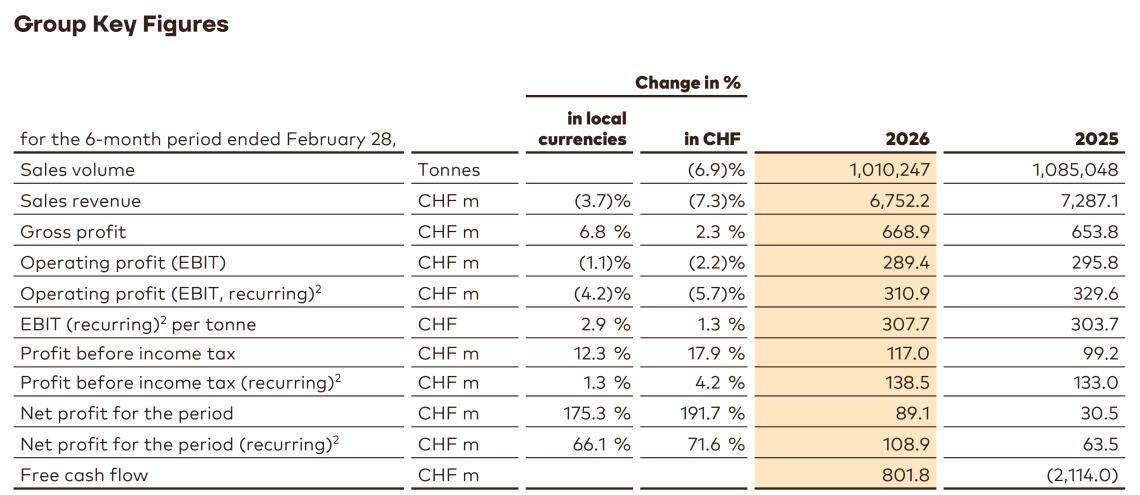
Barry Callebaut Half-Year Results 2025/26 Group Key Figures

1Recurring in local currencies. Please refer to appendix on page 8 (in the PDF) for the detailed recurring results reconciliation.

2 Please refer to appendix on page 8 (in the PDF) for the detailed recurring results reconciliation.

Barry Callebaut Group sales volume decreased by -6.9% to 1,010,247 tonnes in the first six months of fiscal year 2025/26 (ended February 28, 2026). In the second quarter, volume remained impacted by negative market dynamics while improving sequentially to -3.6%, driven by a return to growth in AMEA and Latin America. 

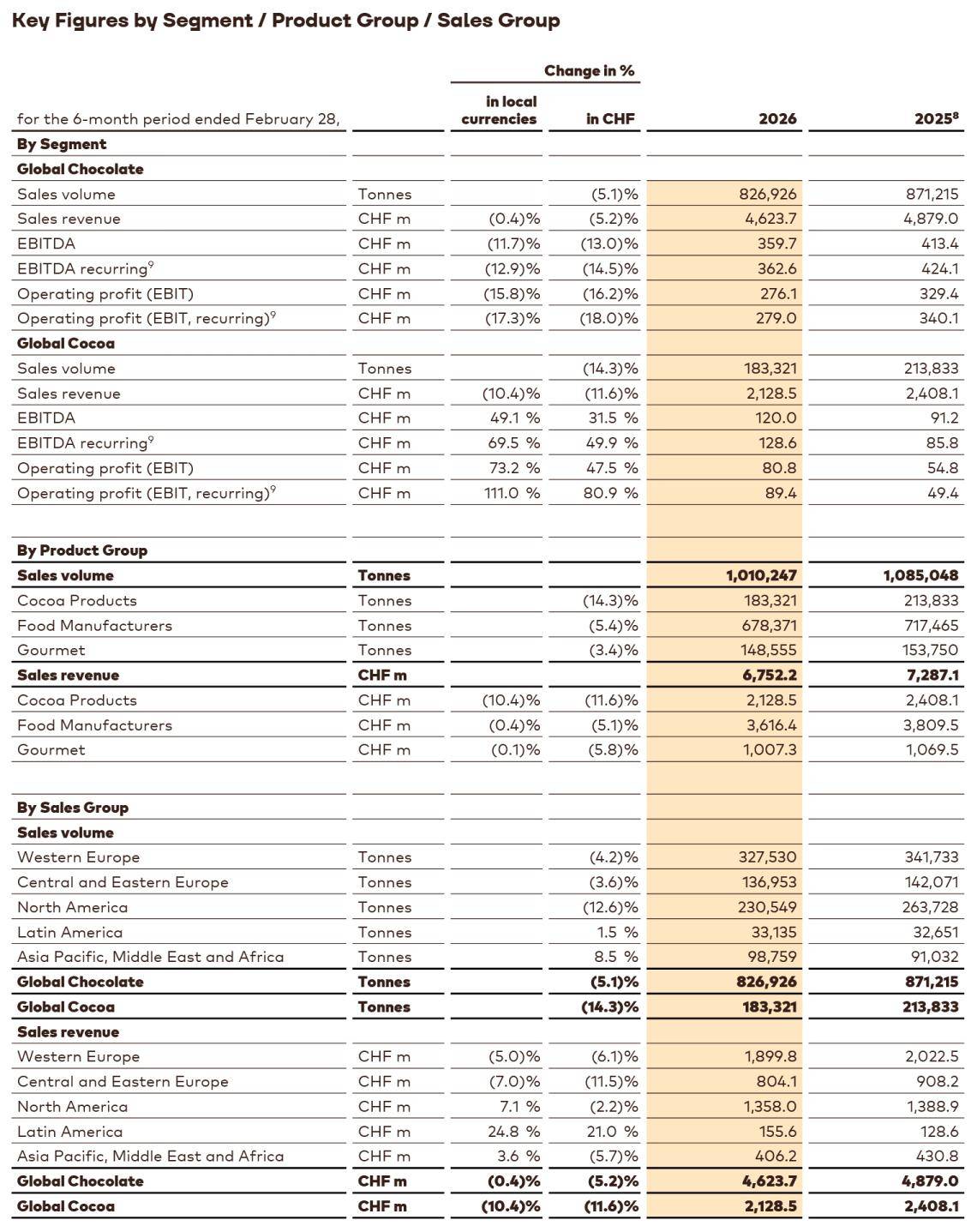
Global Chocolate volumes decreased by -5.1%, ahead of the declining global chocolate confectionery market according to Nielsen3 (-6.5%). Volume development in Food Manufacturers (-5.4%) was impacted by negative market dynamics as customers adapted behaviors in the context of lower demand, as well as by supply disruption in North America. Volumes in Gourmet decreased by -3.4% as competitiveness was temporarily pressured by a high price list in a declining cocoa price environment as well as by supply disruption.

Looking at regional performance within Global Chocolate, Asia Pacific, Middle East and Africa (AMEA, +8.5%) was the strongest contributor. Volume growth in AMEA reached double-digits in the second quarter driven by market share gains in China, momentum with key customers in India and additional business secured in Australia, partly offset by market pressure in Japan and South Korea. Latin America saw slightly positive volume growth (+1.5%) with solid growth in the second quarter, supported by strong performance in Gourmet. Central and Eastern Europe (-3.6%) was impacted by lower volumes for large Food Manufacturer customers due to challenging macroeconomic conditions, while local accounts saw solid growth especially in Türkiye. Volume development in Western Europe (-4.2%) was impacted by market demand softness. North America reported a volume decrease of -12.6%, reflecting network supply disruption following the temporary closure of the St. Hyacinthe factory in Canada in the first quarter and challenging market dynamics. North America saw sequential monthly improvement as the business rebuilds inventories and meets growing customer contracts and orders. 

Sales volume for Global Cocoa declined by -14.3% as a result of negative market demand, particularly in AMEA, as well as the prioritization of volume towards higher profitability segments. The business saw a sequential volume improvement in the second quarter to -5.2%, with early signs of market improvement.

Sales revenue amounted to CHF 6,752.2 million, a decrease of -3.7% in local currencies (-7.3% in CHF) as a result of lower volume. In the second quarter, year-on-year cocoa-related pricing turned negative as a result of the cost-plus pricing model Barry Callebaut uses for the majority of its business.

Gross profit amounted to CHF 668.9 million, up +6.8% in local currencies (+2.3% in CHF), supported by strong cocoa profitability in a more favorable margin environment.

Operating profit (EBIT) recurring2 amounted to CHF 310.9 million, a decrease of -4.2% in local currencies (-5.7% in CHF) compared to the prior-year period. Cocoa profitability was strong, capturing a more favorable margin environment for cocoa. This was more than offset by the impact of volume decreases, supply disruption and a competitive overcapacity market. In particular, Gourmet margins were temporarily pressured by commercial investments related to its long position in a fast declining cocoa price environment. The decrease also reflects a reversal of financing cost pass-through, which negatively impacted EBIT but was neutral at a Net profit level.

Recurring4 EBIT per tonne amounted to CHF 308, up +2.9% in local currencies (+1.3% in CHF). Recurring4 EBIT for Global Chocolate was CHF 279.0 million, down -17.3% in local currencies (-18.0% in CHF) due to lower volumes, supply disruption and the intense competitive environment, particularly given a long Gourmet position in a fast declining cocoa market. Recurring4 EBIT for Global Cocoa was CHF 89.4 million, up +111.0% in local currencies (+80.9% in CHF), supported by a more favourable margin environment. EBIT reported was CHF 289.4 million, compared to CHF 295.8 million in the prior-year period (-1.1% in local currencies and -2.2% in CHF). Net one-off operating expenses amounted to CHF 21.5 million.

Profit before tax recurring4 amounted to CHF 138.5 million, an increase of +1.3% in local currencies (+4.2% in CHF). Net finance costs decreased to CHF -172.4 million compared to CHF -196.7 million in the prior-year period, mostly as a result of debt reduction with repayment of the EUR 263 million term loan in September 2025 and EUR 191 million Schuldscheindarlehen in February 2026 as well as reduction of commercial paper outstanding and bilateral facilities. 

Net profit recurring4 amounted to CHF 108.9 million, up +66.1% in local currencies (+71.6% in CHF), supported by lower income tax expenses. On a recurring basis, income tax expense decreased to CHF 29.6 million versus CHF 69.4 million in the prior-year period. This corresponds to an effective tax rate of 21.4% (prior-year period: 52.2%), which mainly resulted from a more favorable mix of profit before taxes and much lower non-tax-effective losses in some countries. Net profit reported was CHF 89.1 million compared to CHF 30.5 million in the prior-year period.

Net working capital decreased to CHF 3,198.9 million from CHF 5,900.8 million in the prior-year period. The decrease was due to the positive impact from lower cocoa bean prices on inventory value and operational actions to reduce the working capital cycle and optimize sourcing.

Free cash flow generation amounted to CHF 801.8 million, compared to CHF -2,114.0 million in prior-year period, despite the peak harvest and cocoa buying season due to the significant cocoa bean price related working capital decrease and operational actions to reduce the cash cycle.

Net debt decreased significantly to CHF 3,604.3 million, compared to CHF 6,111.6 million in the prior-year period given the impact of lower cocoa bean prices and operational actions to reduce working capital. As a result, further significant deleverage progress was achieved with Net debt / EBITDA recurring declining to 3.9x compared to 6.5x in the prior-year period. When taking into consideration the cocoa bean inventories as readily marketable inventories (RMI), adjusted5 Net debt / EBITDA recurring was 2.7x.


 3 Source: Nielsen volume growth excluding e-commerce – 26 countries, September 2025 - January 2026. Data subject to adjustment to match Barry Callebaut's reporting period. Nielsen data only partially reflects the out-of-home and impulse consumption.
 4 Please refer to appendix on page 8 (in the PDF) for the detailed recurring results reconciliation.
 5Net debt adjusted for cocoa bean inventories regarded by the Group as readily marketable inventories (February 2026: CHF 1,077.6 million; February 2025: CHF 3,192.5 million).

 

Borrowing Base Facility

On April 13, 2026, Barry Callebaut completed its inaugural EUR 2.0 billion sustainability‑linked borrowing base facility, marking an important milestone in the diversification of its funding sources and the alignment of its financing strategy with its sustainability objectives. The facility comprises a total of EUR 1.6 billion of committed financing, consisting of: a EUR 1.2 billion Tranche A with a tenor of three years; a EUR 0.4 billion Tranche B with a tenor of one year; and an uncommitted Tranche C of EUR 0.4 billion providing additional short‑term flexibility. The facility has a revolving character, with a borrowing base linked to the Group’s underlying inventory asset base and is available subject to customary conditions for this type of facility. The facility has been structured by Rabobank acting as sole coordinator along with DBS Bank, ING Bank, Société Générale and UBS Switzerland acting as Bookrunning Mandated Lead Arrangers.

Focus for Growth

Following a turbulent period of industry disruption and transformation at Barry Callebaut, action is required to drive sustained profitable growth and reinvigorate the organization behind a reduced set of priorities to stabilize fundamentals and further step-up service levels and quality. To achieve this, there is a compelling need for focus:

  • Focus Commercial on distinct growth opportunities, prioritizing key markets and segments. Scaling select margin accretive Specialties globally and reintroducing a clear Gourmet brand proposition

  • Focus Operational on restoring fundamentals. Aligning growth capacity with evolving customer needs, restoring service levels and enhancing core processes & data visibility 

  • Focus Organizational on the most impactful initiatives and restore a customer-centric winning culture. Moving to a smaller, more commercially focused leadership team, to empower regional decision-making and support the attraction and retention of key talent. In parallel, taken action to enhance global customer account alignment under direct CEO oversight to drive stronger regional execution and accelerate the deployment of innovation

By driving focus, restoring fundamentals and taking a customer-centric approach, this will enable Barry Callebaut to return to sustained volume and market share growth and ultimately unlock strong financial performance. A full update on the Focus for Growth plan will be shared in June.

Guidance

Barry Callebaut updated its outlook for fiscal year 2025/26, focusing on volume and leverage while taking short-term action to protect market share and support growth:

  • Group volume is now expected to decrease between -1% and -3%, with a return to positive growth in the second half. 

  • On profitability, the Group expects a mid-teens decrease in EBIT recurring in local currencies with the majority of the absolute decrease recovered at the level of Profit before tax recurring in local currencies. In the context of significantly lower cocoa bean prices, the Group is taking short-term action to protect market share and prioritize growth, including in Gourmet following temporary long positions as well as interventions to prioritize service level improvement. In the second half, cocoa profits are also expected to normalize. Profitability outlook is subject to potential impacts from disruption in the Middle East.

  • Deleverage progress is expected to continue with a plan to reach <3.0x Net debt / EBITDA recurring, with a working cocoa bean price assumption of around GBP 3,000.

More detailed financial information can be found in the Half-Year Results 2025/26 Report.

Barry Callebaut Half-Year Results, Fiscal Year 2025/26, Presentation / Webcast

Date:Thursday, April 16, 2026, from 09:00am CEST

This will be a virtual presentation for analysts and investors, hosted by Hein Schumacher, CEO and and Peter Vanneste, CFO, which can also be followed via telephone or webcast. Dial-in and access details can be found here.

Financial Calendar for Fiscal Year 2025/26

(September 1, 2025 to August 31, 2026)

9-Month Key Sales Figures 2025/26July 9, 2026
Full-Year Results 2025/26November 4, 2026
Annual General Meeting 2025/26December 9, 2026
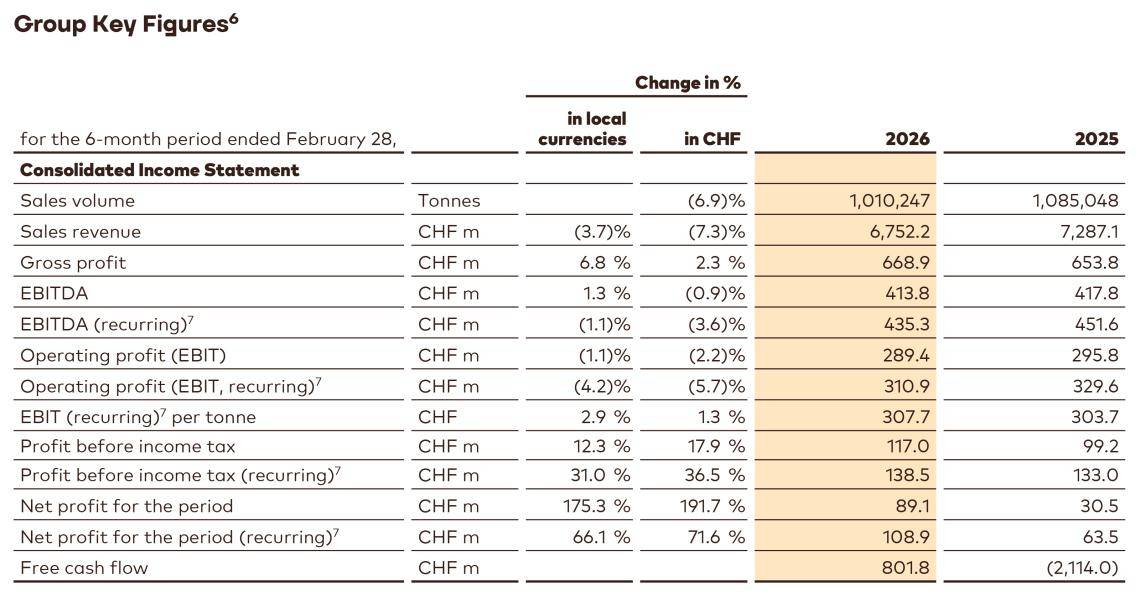
Barry Callebaut Half-Year Results 2025/26 Group Key Figures

6Financial performance measures, not defined by IFRS, are defined in the Annual Report 2024/25 on page 138.

7Please refer to appendix on page 8 (in the PDF) for the detailed recurring results reconciliation.

Barry Callebaut Half-Year Results 2025/26 Key Figures by Segment / Product Group / Sales Group

8Certain customers have been shifted to a different product group to better serve them. The minor reallocation represented less than 1% of the total volume and sales revenue in fiscal year 2024/25. 

9Please refer to appendix on page 8 (in the PDF) for the detailed recurring results reconciliation.

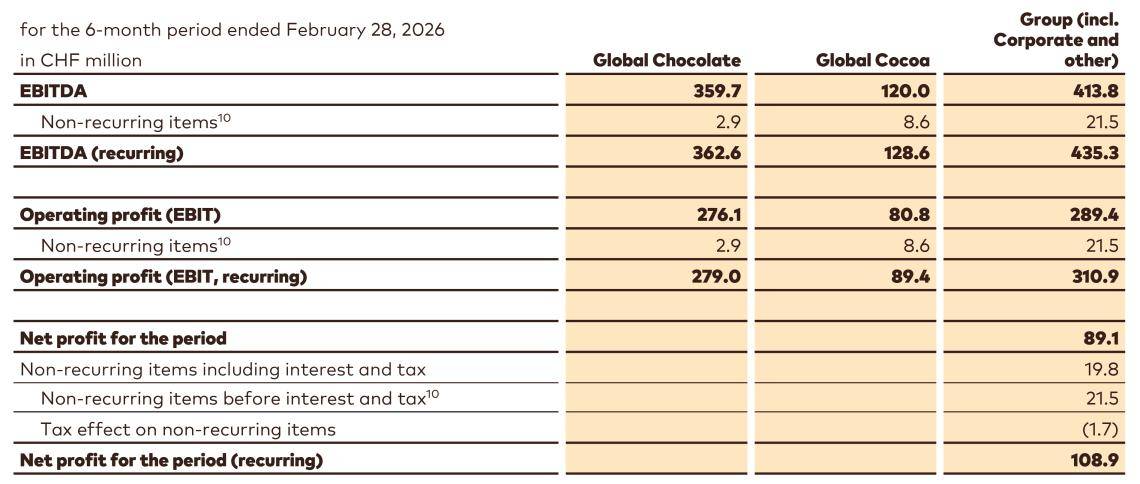
Appendix: Recurring results reconciliation

The reconciliation of non-recurring items of the first six months of the fiscal year 2025/26 and their impact on the Group's Key Alternative Performance Measures can be found in the table below. Non-recurring items of the comparative six-month period can be found in the Half-Year Report 2024/25.

Barry Callebaut_Half_Year_Results_2025_26_Recurring results reconciliation

10 Please refer to Note 3 of the Consolidated Interim Financial statements for more details.

Appendix: Price developments of key raw materials

During the first six months of fiscal year 2025/26, terminal market11 prices for cocoa beans declined as a second consecutive Cocoa surplus continued to materialize. On average, cocoa bean prices decreased by -42% versus the prior-year period and closed the period at GBP 2,057, -61% below the level at the start of the fiscal year. The period saw good main crop arrivals in West Africa, alongside improved prospects for the mid-crop, and sustained pressure on Cocoa grinding in Q4 of the calendar year, thus continuing to replenish global stocks to more healthy levels.

Global sugar prices averaged -22% lower than the same period in the prior-year period driven by improving supply in key regions, whilst demand remained stable. In Europe, sugar prices declined -13% despite reduced plantings, reflecting higher than expected yields for the 2025/26 campaign and lower prices in the world market. 

Dairy prices declined by -16% compared to the previous year. The decrease is mainly due to low energy and feed costs, favorable weather conditions and the absence of further cow diseases that supported a broad increase in global milk production. This led to an oversupplied dairy market against relatively stable demand throughout the period.

11 Source: London terminal market prices for 2nd position, September 2025 to February 2026. Terminal market prices exclude Living Income Differential (LID) and country differentials.

About Barry Callebaut Group:

With annual sales of about CHF 14.8 billion in fiscal year 2024/25, the Zurich-based Barry Callebaut Group is the world’s leading solutions provider of high-quality chocolate experiences across the full spectrum of chocolate, cocoa, cacao coatings and non-cocoa alternatives – from sourcing and processing cocoa beans to crafting premium chocolates, fillings and decorations. The Group operates more than 60 production facilities worldwide and employs a diverse, committed workforce of over 13,000 people. Barry Callebaut serves as a trusted partner for the entire food industry, from large-scale food manufacturers to artisanal and professional users such as chocolatiers, pastry chefs, bakers, hotels, restaurants and caterers with Callebaut® as its main global brand. The Barry Callebaut Group is dedicated to making sustainable chocolate the norm – helping secure the future of cocoa and improving the livelihoods of cocoa farmers. It supports the Cocoa Horizons Foundation which aims to shape a sustainable future for cocoa and chocolate.

Follow the Barry Callebaut Group:


Contact for the media:

Taryn Ridley 
VP Corporate Communications & Public Affairs
Barry Callebaut AG
+41 79 459 44 98
[email protected]

for investors and financial analysts:

Sophie Lang
Head of Investor Relations
Barry Callebaut AG
+41 79 275 83 95
[email protected]

연락